
In this article, we are going to explore a correlation between USDINR & the price of Crude Oil in MCX. In general, when a commodity is quoted in terms of a currency, we can expect an inverse correlation between the pair of assets. For example, since Gold is globally denominated in terms of USD, when Dollar rises (as expressed in Dollar Index), we generally witness a sell-off in the yellow metal. The same logic can be extended to all other commodities (in Dollar terms) & WTIC Crude Oil is not an exception either. However, today we are going to limit our discussion to the Indian context: Can we expect the same inverse correlation to hold between the pairs of USDINR & MCX Crude Oil, which is denominated in Rupee terms?
Before we proceed with any correlation analysis, it is important to know the fundamental forces driving the relationship. In the Indian context, the inverse correlation between USDINR & MCX Crude Oil prices is in fact a possibility worth exploring. Since a large portion of our energy requirement is imported from other countries & paid in Dollar terms, a strong dollar (or a weak Rupee) is likely to push energy prices higher in our domestic market. Noteworthy, because we are measuring the strength of Rupee in USDINR terms, the same inverse correlation we are expecting between the two pairs shall manifest itself as a direct correlation.
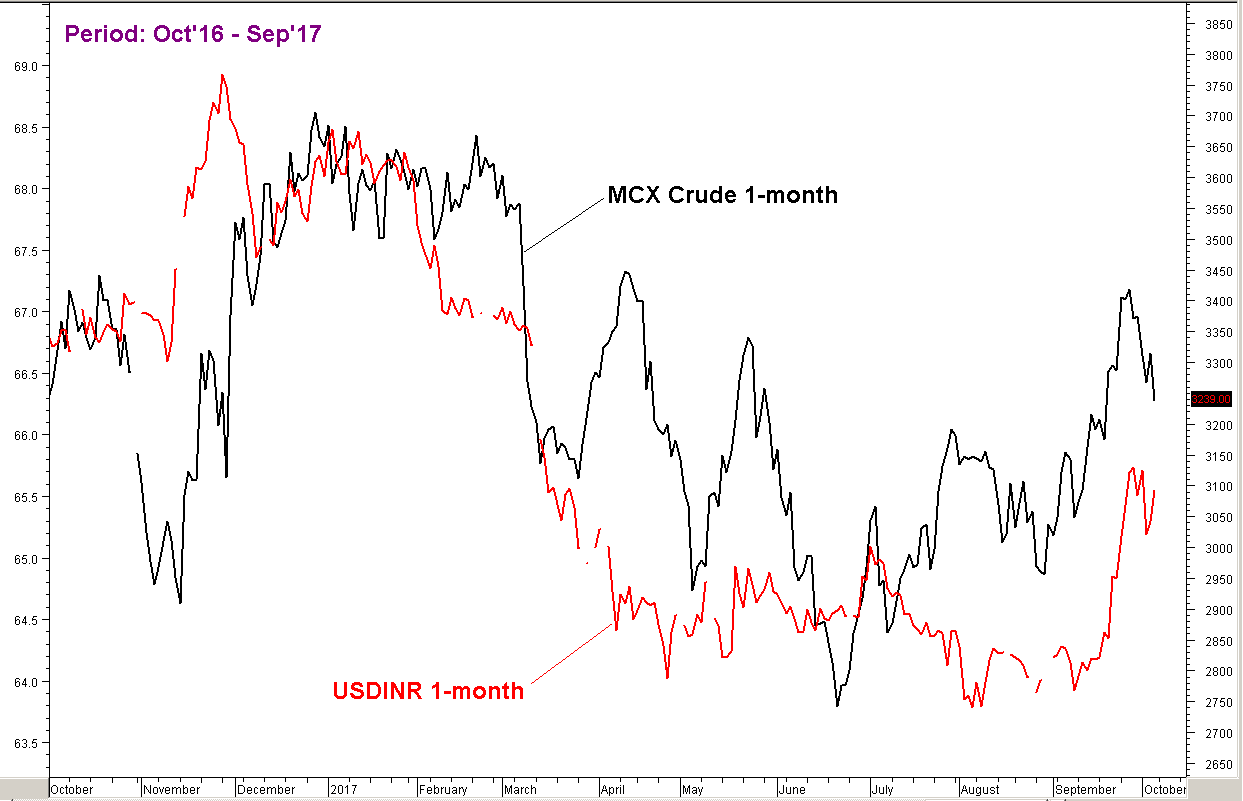
In reference to the adjoined figure, we first visually observe that there is indeed a some similarities between the two asset prices in their primary trend direction, as they often rise & fall together (direct correlation), but it does not occur always. That is only to be expected because USDINR is one among many contributors to the price of MCX Crude Oil. In more specific terms, we derive the 50-day R-Square value of the pairs as 0.53, which implies 53% of the price variation of MCX Crude Oil prices could be explained by USDINR, based on past 1 year of data. This is not a particularly strong correlation but also significantly larger than a random estimation.
Can we convert this information into a trading system? The knowledge that we acquired so far on positive correlations between the pairs is not sufficient to work out a trading model in MCX Crude Oil (based on USDINR) because we still do not know the future direction of USDINR. However, we can attempt to work out a trading model based on Intermarket Linear Regression Slope Divergence between the two assets. This idea requires a more detailed discussion which is not possible here, but some rough outlines are given below. Interested readers might refer to the works of Markos Katsanos.
Here, we are assuming USDINR as the Intermarket security & MCX Crude Oil as the base security. The process starts with calculation of the slope of the Linear Regression Line for both securities & then they are normalized for their respective volatilities. The intermarket oscillator is derived by subtracting the slope of the base security from the intermarket security. A buy signal in MCX Crude Oil is generated when the intermarket oscillator calculated as above rises above a threshold value & subsequently declines. Conversely, a sell signal is generated when it declines below a threshold value & subsequently rises. The time window for calculation of Linear Regression Slope, determination of the threshold values & the risk management rules are quite obviously a function of backtesting.
………………………………………………………………………………..
Bibliography:
Inputs are taken with gratitude from:
1. Intermarket Technical Analysis: Trading Strategies for the Global Stock, Bond, Commodity & Currency Markets by John Murphy
2. Intermarket Trading Strategies by Markos Katsanos


